Research Group Public Law and Computer Science
| T.-T. Prof. Dr. iur. Frederike Zufall | Head of the Research Group |
| Dr. iur. Gustavo Gil Gasiola | Senior Researcher (full-time) |
| Dr. Maitrayee Pathak | Senior Researcher (part-time) |
| Abhilasha Abhilasha | Academic Researcher |
| Thomas Holzhausen | Researcher (part-time) |
| Dr. jur. Arian Henning | Affiliated Researcher |
| Stefanie Fuchs | Assistant and Office Management |
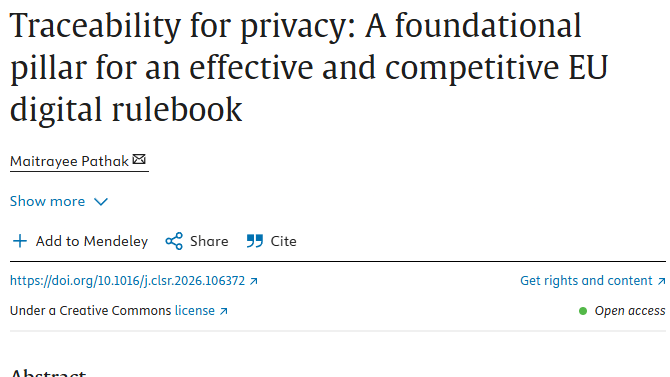
In a paper published in the journal Computer Law & Security Review, Maitrayee Pathak analyzes the traceability mandates from the GDPR to the AI Act, compares technical architectures based on blockchains, attestations and cryptographic claims, and proposes a standardized, privacy-preserving traceability layer for the EuroStack called EU-Trace.
Read here
Gustavo Gil Gasiola and Frederike Zufall, together with co-authors from the Max Planck Institute for Security and Privacy, have been awarded the CNIL/EHESS Award 2026 for their paper “Do Citizens Agree with the EU AI Act? Public Perspectives on Risk and Regulation of AI Systems”. The internationally recognized prize was awarded at the Privacy Research Day in France, hosted by the French data protection authority CNIL in conjunction with the G7 meeting.
Read here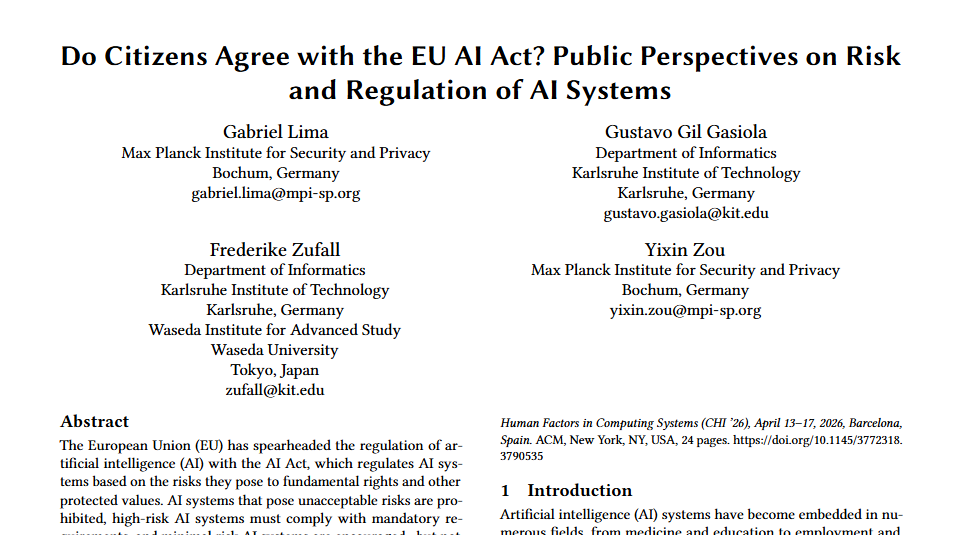
Frederike Zufall and Gustavo Gil Gasiola (with Gabriel Lima and Yixin Zou from MPI for Security and Privacy, Bochum) co-authored a paper on public perspectives on the risk and regulation of AI systems, which was presented at the Conference on Human Factors in Computing Systems (CHI) in Barcelona. The paper challenges the tiered approach of the AI Act, showing that people might support horizontal regulation requiring minimal standards for AI systems. It also provides implications for developers seeking to create AI that aligns with public expectations.
Read here
Frederike Zufall is a co-organizer of the new "AI for Law" workshop at the International Conference for Machine Learning (ICML) 2026. The call for papers and additional information can be found here.
Read here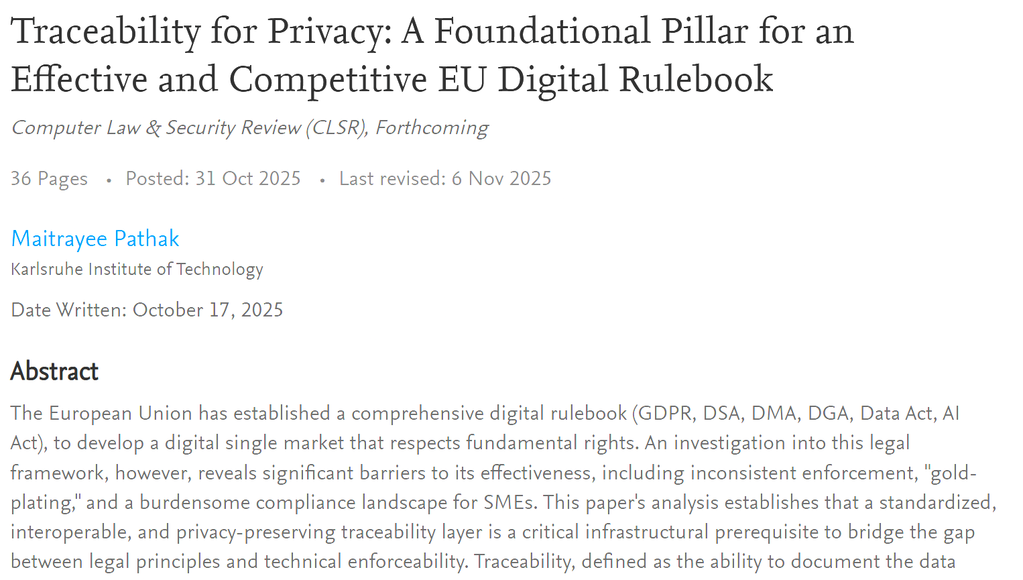
Maitrayee Pathak was invited to speak about her publication on Traceability for Privacy in a workshop organized by the SmartLawHub and the Brussels Privacy Hub held at HEC Paris on March 23-24 in connection with the forthcoming special issue in Computer Law & Security Review. This legal-technical paper explores traceability, defined as the ability to document the data lifecycle and link processing to a verifiable legal basis. It analyzes the traceability mandates from the GDPR to the AI Act, compares technical architectures based on blockchains, attestations and cryptographic claims, and proposes a standardized, and privacy-preserving traceability layer as a critical infrastructural prerequisite to bridge the gap between legal principles and technical enforceability. It also proposes embedding it in the Eurostack vision for a more competitive, transparent and accountable digital Europe.
Read here
The chair of public law and computer science (T.T.-Prof. Dr. iur. Frederike Zufall) is looking for a doctoral researcher with a keen interest in interdisciplinary research between public law and computer science.
Full offer here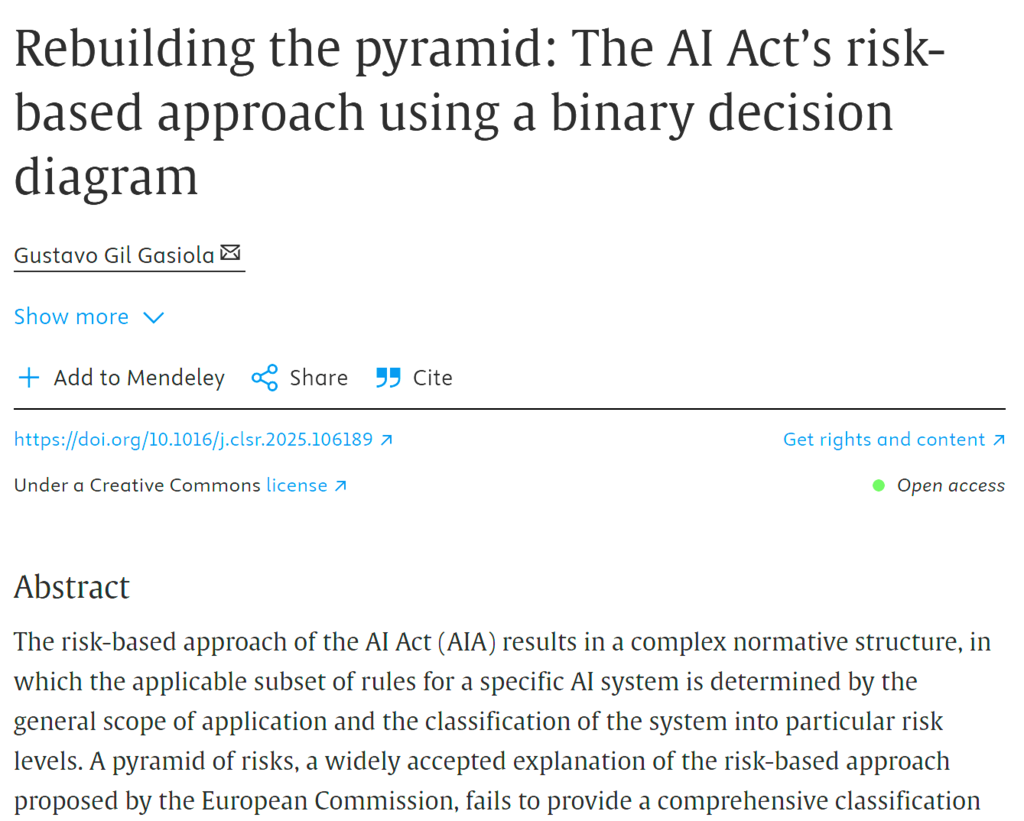
In a paper published in the journal Computer Law & Security Review, Gustavo Gil Gasiola examines the Commission’s pyramid of risks and uses a binary decision diagram to visualise and interpret the risk-based approach of the AI Act.
Read here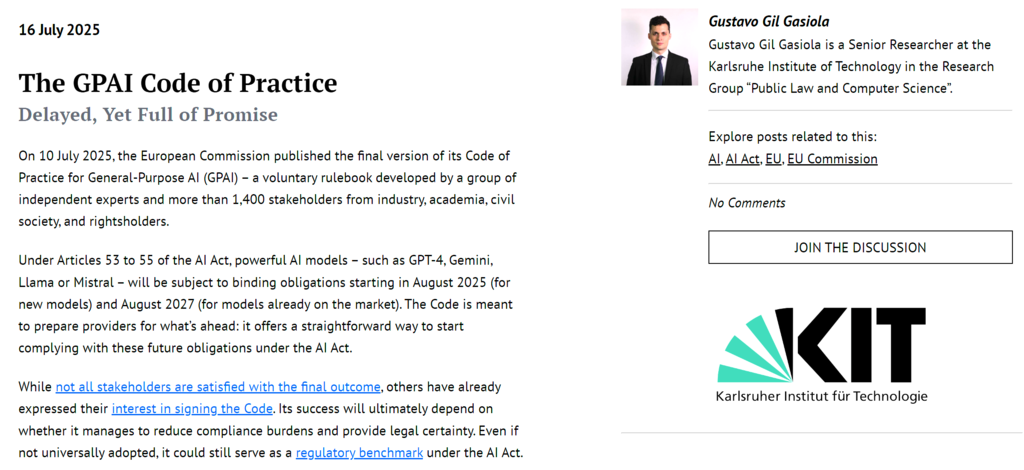
On Verfassungsblog, Gustavo Gil Gasiola analyses the Commission’s Code of Practice, intended to facilitate compliance with the AI Act's obligations for general-purpose AI models.
Read here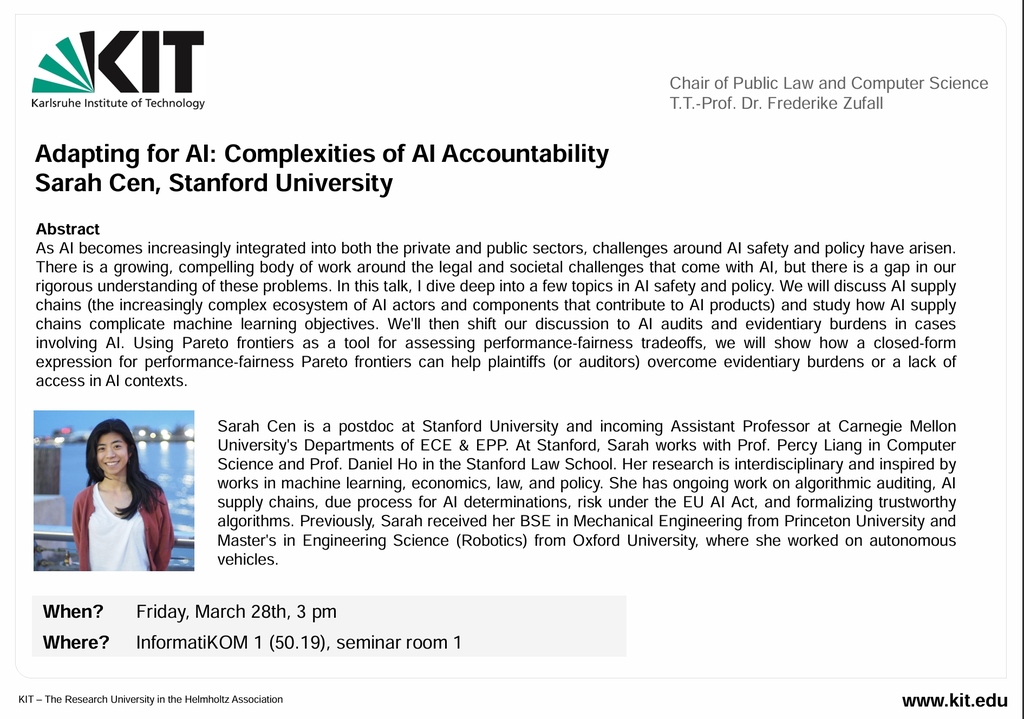
Sarah Cen, Stanford University (CS and Law School), is going to give an invited talk on "Adapting for AI: Complexities of AI Accountability“ on March 28th, 3 pm in the InformatiKOM.
She will dive deep into a few topics in AI safety and policy, discuss AI supply chains and explore how they complicate machine learning objectives. The discussion will then shift to AI audits and evidentiary burdens in cases involving AI. Using Pareto frontiers as a tool for assessing performance-fairness tradeoffs, the talk will show how a closed-form expression for performance-fairness Pareto frontiers can help plaintiffs (or auditors) overcome evidentiary burdens or a lack of access in AI contexts.
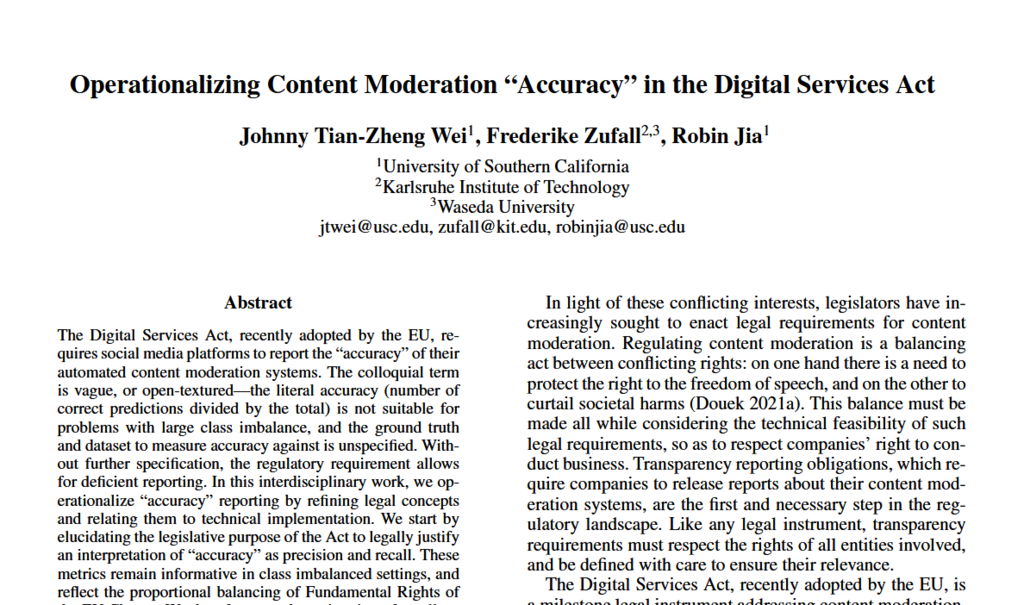
Frederike Zufall co-authored (with Johnny Wei and Robin Jia from USC) paper on operationalizing content moderation "accuracy" in the Digital Services Act appeared at the AAAI/ACM Conference on AI, Ethics and Society (AIES) in San José. Identifying a contradiction in its literal understanding, the interdisciplinary work relates the underspecified term to the affected fundamental rights - operationalizing it as a trade-off between precision and recall - and proposes a stratified sampling approach to meet the reporting requirements of the DSA.
Read here
Gustavo Gil Gasiola publishes a book entitled "Datenübermittlung in der öffentlichen Verwaltung"(in English: Data Transfer in Public Administration). This book examines the lawfulness of data transfer in public administration according to the criteria of lawfulness, purpose limitation and transparency.
Read here
Co-authored paper by Frederike Zufall (with Lin Kyi, Sushil Ammanaghatta Shivakumar, Cristiana Teixeira Santos, Franziska Roesner and Asia J. Biega) wins the Council of Europe’s Stefano Rodotà Data Protection Award 2024
Read here
Paul Friedl and Gustavo Gil Gasiola (Public Law and Computer Science) publish a blog post examining the EU’s Artificial Intelligence Act on Verfassungblog.de
Read here